“Thee do we worship, Ramadan Mubarak to my Muslim friends and colleagues! May His blessings be a beacon for you for the next year.
and Thine aid we seek.
Show us the straight way.”
—from the Qur'an [1:5-6]For thirty days, there is strict fasting, prayers, self-accountability, and charity from sunrise to sunset. Fasting during this month is often thought to figuratively burn away all sins. Furthermore, the Prophet Muhammad told his followers that the gates of Heaven would be open all the month and the gates of Hell would be closed.
26 September 2006
The fast of Ramadan
24 September 2006
Rosh Hashanah
One of the prayers often recited is “Avinu malkeinu” (Our Father, Our King), originated on fast days as a plea for rain. Listen to Barbra Streisand's moving interpretation of the song, taken from her 1997 album Higher Ground. To my Jewish friends and colleagues, l'shanah tovah tikatev v'taihatem! May you be inscribed and sealed for a good year!

The power of religious rhetoric
POPE BENEDICT XVI apologized four times this week for enraging Muslims worldwide. In a university speech, the Pope had used an uncharitable quotation from 14th-century Christian Byzantine emperor Manuel II Paleologus. He said, “Show me just what (the Prophet) Muhammad brought that was new and there you will find things only evil and inhuman, such as his command to spread by the sword the faith he preached.” This is not the first time that the leader of the Roman Catholic Church found himself in a row with followers of the world's faiths. In a 1997 interview, the erstwhile Joseph Cardinal Ratzinger described Buddhism as “auto-erotic spirituality” that would be the source of “the undoing of the Catholic church”—remarks still repeated by the Buddhists years after he said them. Last May, he referred to “signs of religious intolerance that have troubled some regions in India”—comments that discomfited Hindu leaders in the Indian government. Over a week later, while visiting Auschwitz, the pontiff claimed that “by destroying Israel, (the Nazi) ultimately wanted to tear up the taproot of the Christian faith”—views taken by some Jews to mean that the real victims of the Holocaust were the Christians. Such rhetoric—and the uneasy reactions that ensued from other religions and fed and ripped apart by powerful media—only highlights the piercing truthfulness of the message addressed by the Universal House of Justice (the governing council of the Bahá’í Faith) to the world’s religious leaders in April 2002. I quote below parts of the letter that touch on the ongoing issues (highlights mine). In the same message, the Universal House of Justice has offered us the following reassuring guidance: There can be no doubt whatever that the peoples of the world, of whatever race or religion, derives their inspiration from one heavenly Source, and are the subjects of one God. The difference between the ordinances under which they abide should be attributed to the varying requirements and exigencies of the age in which they were revealed. All of them, except a few which are the outcome of human perversity, were ordained of God, and are a reflection of His Will and Purpose. Arise and, armed with the power of faith, shatter to pieces the gods of your vain imaginings, the sowers of dissension amongst you. Cleave unto that which draweth you together and uniteth you.In contrast to the processes of unification that are transforming the rest of humanity's social relationships, the suggestion that all of the world's great religions are equally valid in nature and origin is stubbornly resisted by entrenched patterns of sectarian thought. The progress of racial integration is a development that is not merely an expression of sentimentality or strategy but arises from the recognition that the earth's peoples constitute a single species whose many variations do not themselves confer any advantage or impose any handicap on individual members of the race.
“The greater part of organized religion stands paralyzed at the threshold of the future”Other segments of society embrace the implications of the oneness of humankind, not only as the inevitable next step in the advancement of civilization, but as the fulfillment of lesser identities of every kind that our race brings to this critical moment in our collective history. Yet, the greater part of organized religion stands paralyzed at the threshold of the future, gripped in those very dogmas and claims of privileged access to truth that have been responsible for creating some of the most bitter conflicts dividing the earth's inhabitants.
The consequences, in terms of human well-being, have been ruinous. It is surely unnecessary to cite in detail the horrors being visited upon hapless populations today by outbursts of fanaticism that shame the name of religion. Nor is the phenomenon a recent one. To take only one of many examples, Europe's sixteenth century wars of religion cost that continent the lives of some thirty percent of its entire population. One must wonder what has been the longer term harvest of the seeds planted in popular consciousness by the blind forces of sectarian dogmatism that inspired such conflicts.
Religion, as we are all aware, reaches to the roots of motivation. When it has been faithful to the spirit and example of the transcendent Figures who gave the world its great belief systems, it has awakened in whole populations capacities to love, to forgive, to create, to dare greatly, to overcome prejudice, to sacrifice for the common good and to discipline the impulses of animal instinct. Unquestionably, the seminal force in the civilizing of human nature has been the influence of the succession of these Manifestations of the Divine that extends back to the dawn of recorded history.The implications for today are summed up by Bahá'u'lláh in words written over a century ago and widely disseminated in the intervening decades:
There is certainly wide differences among the world's major religious traditions with respect to social ordinances and forms of worship. Given the thousands of years during which successive revelations of the Divine have addressed the changing needs of a constantly evolving civilization, it could hardly be otherwise. . . What cannot be morally justified is the manipulation of cultural legacies that were intended to enrich spiritual experience, as a means to arouse prejudice and alienation. The primary task of the soul will always be to investigate reality, to live in accordance with the truths of which it becomes persuaded and to accord full respect to the efforts of others to do the same. . .
“Religion has awakened in whole populations capacities to love, to forgive, to create, to dare greatly, to overcome prejudice, to sacrifice for the common good”We come finally to an issue that we approach with some diffidence as it touches most directly on conscience. Among the many temptations the world offers, the test that has, not surprisingly, preoccupied religious leaders is that of exercising power in matters of belief. . . The unheralded inner victories won in this respect by unnumbered clerics all down the ages have no doubt been one of the chief sources of organized religion's creative strength and must rank as one of its highest distinctions. To the same degree, surrender to the lure of worldly power and advantage, on the part of other religious leaders, has cultivated a fertile breeding ground for cynicism, corruption and despair among all who observe it. The implications for the ability of religious leadership to fulfil its social responsibility at this point in history need no elaboration.
Because it is concerned with the ennobling of character and the harmonizing of relationships, religion has served throughout history as the ultimate authority in giving meaning to life. . . (It) has simultaneously been the chief force binding diverse peoples together in ever larger and more complex societies . . . The great advantage of the present age is the perspective that makes it possible for the entire human race to see this civilizing process as a single phenomenon, the ever-recurring encounters of our world with the world of God.
Inspired by this perspective, the Bahá'í community has been a vigorous promoter of interfaith activities from the time of their inception. . . We owe it to our partners in this common effort, however, to state clearly our conviction that interfaith discourse . . . must now address honestly and without further evasion the implications of the over-arching truth that called the movement into being: that God is one and that, beyond all diversity of cultural expression and human interpretation, religion is likewise one.
With every day that passes, danger grows that the rising fires of religious prejudice will ignite a worldwide conflagration the consequences of which are unthinkable. Such a danger civil government, unaided, cannot overcome. Nor should we delude ourselves that appeals for mutual tolerance can alone hope to extinguish animosities that claim to possess Divine sanction. The crisis calls on religious leadership for a break with the past as decisive as those that opened the way for society to address equally corrosive prejudices of race, gender and nation. Whatever justification exists for exercising influence in matters of conscience lies in serving the well-being of humankind. At this greatest turning point in the history of civilization, the demands of such service could not be more clear. “The well-being of mankind, its peace and security, are unattainable”, Bahá'u'lláh urges, “unless and until its unity is firmly established.”
23 September 2006
Bears and beers

Zhang Xinyan knew, and it got him to a panda-monic brawl and a hospital bed afterwards. The unbearable story goes this way. Last Tuesday, the 35-year-old Chinese migrant got drunk, visited the Beijing Zoo, saw the sleeping 6-year-old panda bear named Gu Gu, entered his den, and decided to hug him. “I just wanted to touch it,” recalled Zhang. “I was so dizzy from the beer. I don't remember much.” Well, we do remember what happened next. Startled (and possibly insulted for the rude awakening), Gu Gu bit Xinyan's leg. Angered (and possibly insulted for the rude welcome), Zhang bit Gu Gu's back and then delivered a kick for good measure. Gu Gu bit the leg that kicked, and a scuffle ensued for 15 minutes. Guess who won. “Its skin was quite thick,” Zhang reflected later, lying on the hospital bed with blood-soaked bandages. I am sure this biting remark would have merited a retort from Gu Gu: “Yeah, and his face was thick enough to mistake me for a wife!”
22 September 2006
Coup in Thailand
THAILAND HAS such a long history of coup d'etats that this week's military revolt reminded me of an old joke. A tour guide brought a female tourist to a kick-boxing arena in Bangkok. “This is Muay Thai, our national pastime, ” he began. “It involves kicking, punching, elbowing, kneeing, and head-butting the enemy to wear him down and knock him out.” The lady gasped, “It is revolting!” The tour guide responded, “That is our second national pastime.”
21 September 2006
FOCAL POINT : Curumin, “Achados e Perdidos”
BRAZILIAN MUSICIAN CURUMIN (Luciano Nakata Albuquerque) has released his debut album “Achados e Perdidos” (“Lost and Found”). The collection reflects Curumin's global roots: born to Spanish and Japanese parents, raised in Brazil, world music student at Gaviões da Fiel, and band leader of Zomba.
The track above is the infectious “Tudo Bem Malandro”, from the album that fuses ukelele-driven Brazilian beats with funk, hip-hop, reggae, and psychedelic electronica.
17 September 2006
FOCAL POINT : Hildegard von Bingen, “Caritas abundat”

She is the first female composer in documented music history
WHEN ROMAN CATHOLICS commemorate today's feast of the Blessed Hildegard von Bingen (1098-1179), they remember a twelfth-century German abbess who received divine visions at the age of five. Growing up a Catholic, I savored the Ladybird picture book that told her life story as an extraordinary, powerful woman who ventured where few—let alone women—dared in her time. She wrote major works of theology and medicine, gave public speeches on natural history and healing, and counseled (and chastised) statesmen, royalty, and popes. For a woman to do all this in the twelfth century brings the cause of womanhood right bang on front row, center! What is also striking about Hildegard von Bingen is that she remains the oldest known composer with a recorded biography—effectively making her the first female composer in documented music history. Her music is liturgical and devotional, wrapped around poetry that came to her in visions. Soaring over two octaves, the songs are difficult to sing today; imagine how they must have been performed during her time. Hildegard once described her works as a means of reliving the joy and beauty of the garden of Eden. I describe her work as Eve's supreme creative progeny. Listen to “Caritas abundat” (Divine love abounds), a short piece with a beautiful vocal line spread among many notes, almost wordless, always soothing, performed here by The Shelter Music Boston Ensemble.
Pluto comes home

Pluto in my flat with his toy and and his potential daybed
I HAVE a new cat, and his name is Pluto. He is a Persian kitten, the third in a litter born on 6 July 2006 in Pune, the second-largest city in the state of Maharashtra. I took him home through seven hours of driving back to Mumbai, no thanks to the sudden downpour that clogged the streets. Through the havoc, he took turns sleeping on my lap and playing with my necklace. What a fantastic preview of things to come as he grows up. Or as we grow up together. Those of you who knew about my cats in Israel (Tiger, Cleopatra, Java, and that moogie that almost killed me in the kitchen) will be delighted that Pluto not only shares their brown colors (he is a red tabby), he also likes to dance with someone looking like Behi Sobhani. (The breeder, a young Indian man who also breeds bonsais and terrariums, looks like Behi Sobhani. When he jumped up to fetch something from the kitchen, Pluto must have thought that the young man was about to dance, so he jumped up along with him.)
14 September 2006
FOCAL POINT : Christopher Logue, “Come to the Edge”

BRITISH POET Christopher Logue (born 1926) wrote the following verse for a 1968 festival honoring French avant-garde poet Guillaume Apollinaire. I am delighted at the poem's reference to the need for leaders to initiate the process of overcoming barriers that hinder creativity.
Come to the edge.
We might fall.
Come to the edge.
It’s too high!
COME TO THE EDGE!
And they came,
and he pushed,
and they flew.
Source: Christopher Logue, New Numbers (1969)
12 September 2006
Five years ago today
IN REMEMBERING 9/11, we take solace in the following guidance contained in the 10 February 1980 message of the Universal House of Justice to Iranian Bahá'ís throughout the world:
In such an afflicted time, when mankind is bewildered and the wisest of men are perplexed as to the remedy, the people of Bahá, who have confidence in His unfailing grace and divine guidance, are assured that each of these tormenting trials has a cause, a purpose, and a definite result, and all are essential instruments for the establishment of the immutable Will of God on earth. In other words, on the one hand humanity is struck by the scourge of His chastisement which will inevitably bring together the scattered and vanquished tribes of the earth; and on the other, the weak few whom He has nurtured under the protection of His loving guidance are, in this Formative Age and period of transition, continuing to build amidst these tumultuous waves an impregnable stronghold which will be the sole remaining refuge for those lost multitudes. Therefore, the dear friends of God who have such a broad and clear vision before them are not perturbed by such events, nor are they panic-stricken by such thundering sounds, nor will they face such convulsions with fear and trepidation, nor will they be deterred, even for a moment, from fulfilling their sacred responsibilities.
The depth of the message is as useful today as it was more than twenty-five years ago.
11 September 2006
Chasing the chaste me
MY TEAM and I set up the displays for a new store throughout last week, with each one of us responsible for specific areas in the store. One day, Mallika needed my advice in decorating the bedroom showcase, so she asked her young junior assistant Anusha to fetch me from the décors section where I was working.
In the most nonchalant manner, Anusha announced, "Paul, Mallika wants you in the bedroom."
I replied without batting an eyelash, "Tell her that marriage comes first."
The young lady walked away nonplussed as the rest of the team broke in laughter.
10 September 2006
Festival of Ganesh

The Ganesh of the Curry Road community in Mumbai
Image source: Arun Patil
THE PASSING WEEK was a spectacular break in the life of Mumbai. It is the annual Ganeshotsav, eleven days of joyous celebration and great devotion across India to honor the birthday of Lord Ganesh. Revered as the lord of good fortune and destroyer of obstacles, Ganesh is the most beloved and most frequently invoked god in Hinduism. His icon adorns doors facing the east to encourage smooth passage, and his mantra is recited to start any task or event. Ganesh has the widest following in Mumbai and the rest of Maharashtra.
The festival starts with Ganesh Chaturthi, when ornately dressed Ganeshas (Ganesh idols) are displayed in pandals (raised platforms) at home for family worship. However, the devotion to the cheerful elephant-headed god is so great that the worship—and adornment—spills from homes onto the streets. Huge, brightly festooned tents rise in the middle of roads, which shimmer with sparkling strings of light. Most of the idols contained in these tents tower over six meters! On the third and last days of the festival, the Ganeshas are ritually immersed in the nearest body of water. Mumbai practically shuts down to allow processions of people on their way to the Arabian Sea to bid their idols farewell. Mumbai practically shuts down to allow processions of people to bid their idols farewellThese processions are, to say the least, revelry. I was caught in one of these processions while visiting a supplier on the third-day visarjan (immersion) last week. I enjoyed the elaborate displays of Ganeshas in gigantic pandals, but what riveted me was the spectacular show of merrymaking. Firecrackers punctuated the air. Sharp yells accompanied the brass horns and drums that guided the processions. Then there were people dancing wildly in what a colleague of mine insisted was not Indian, but plain street dancing. On my way home much later that night, I saw a pandal with a man striking a pose by flexing his muscles while teenagers pranced around him to some Bollywood-sounding song. This sight sent my driver to endless fits of laughter. (He was still laughing as we reached home.) What also interested me was the question of whether the idols immersed into the waters were non-biodegradable. My colleague mentioned that this is the one singular issue that has plagued Ganeshotsav, and that environmentalists have actively taken this to task. On the bright side, newspapers this week reported that some of the idols have in fact been made of more eco-friendly materials. The morning after the last day, as I drove to work, I saw empty pandals and street hoardings being taken down. The smell of firecrackers still lingered faintly. The stanchions that barricaded the revelers from the traffic were gone. For the masses, who seemed to me to be the only frenzied celebrants of Ganeshatsov, the morning after is once again another ordinary day in the life of Mumbai. On the way to visarjan at Juhu Beach in Mumbai
Media source: YouTube.com
27 August 2006
Back on the block
I'M BACK from a month that was both busy and bizarre. In the aftermath of the Mumbai blasts, several ISPs (including mine) in India blocked BlogSpot.com, TypePad.com, and Geocities.com. This left me (and countless other bloggers) helplessly silent amidst the media hysteria following the terrorist surprises of the past six weeks. This afternoon, I was going to sit down and write about how July was not too jolly and how August augured badly. Then I realized that the events in India, the Middle East, and the United Kingdom have already reached some semblance of an ending. For the time being, I can write about hopeful things.
I am so glad to return to the blogosphere that I spent the whole afternoon today tweaking the site, reclassifying the posts into various categories, and organizing my list of links to other sites worth reading. Keep watching this space. More precisely, watch the space on the left.
12 July 2006
Blasts in Mumbai!
IN VIEW of this early evening's train bombings in Mumbai, please know that I am safe at home. The bombings occurred around the suburb that I live and work in, so the situation was pretty scary.
The local and national mobile phone network is down, though, so I am unable to determine whether my staff and colleagues have been able to reach home safely. The bombings began when people were rushing to get home.
Your thoughts and prayers for the people of India will be very helpful.
10 July 2006
Viva Italia!
THE ROMANS won over the Celtic Gauls in the global theater that was 2006 FIFA World Cup. Congratulations to the Italians and the fans of Italy. In your honor, I present la divina signora Bette Midler with “Mambo Italiano”
E molto dificile resistere Italia! Con pizza! Maria Grazia Cucinotta! Oooh la la! Ooops, that was French. Sorry, Zidane.
09 July 2006
Martyrdom of the Báb
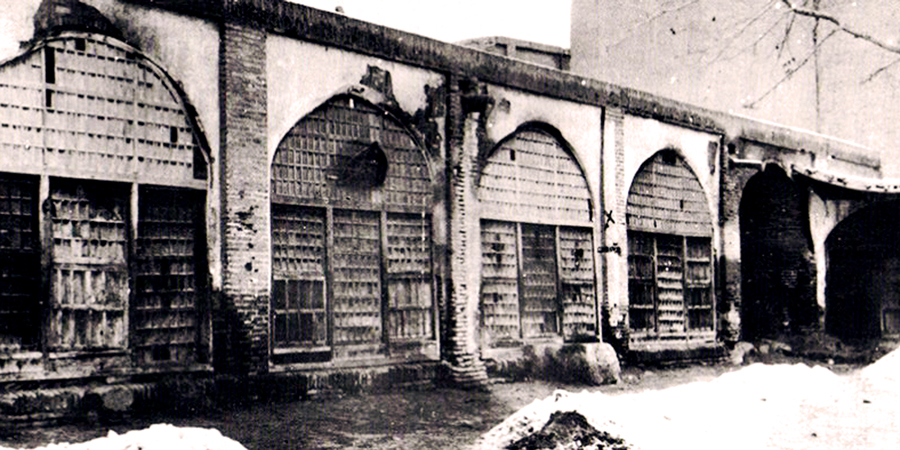
The barracks wall where the Báb was executed on 9 July 1850
AT THE Bahá'í Centre in Mumbai today, I joined over a hundred other members of the Bahá'í Faith in remembering the arrest, torture, imprisonment, and eventual execution of the Báb (born 1819) in Tabriz, Persia, on July 9, 1850. The Báb, whose name meant “the gate” in Arabic, was a Divine Messenger Whose brief mission on earth prepared humanity for the coming of Bahá’u’lláh, the Prophet-Founder of the Bahá'í Faith.
Prior to a special prayer read by Mrs. Zena Sorabjee at noon, we viewed a moving fifteen-minute film that narrated His martyrdom. Once again, I was reminded of the immense potency and meaning of this day, which Shoghi Effendi called a century later as “the most dramatic, the most tragic event” in the history of the Bahá'í Faith.
27 June 2006
The world's rudest cities?

The magazine administered three politeness tests in the main cities of 35 countries where it is published: dropping papers in a street to check helpfulness, counting how often shopkeepers said “thank you”, and testing how often someone held a door open for others.
The results were released last week, and they are surprising. New York City emerged as the most polite city and Mumbai as the least! Here are other findings: Here in Mumbai, citizens have been quick to dispute the results. Over the weekend, newspapers took the city's politeness quotient by interviewing celebrities and common folk. The universal response: you have to live here to understand its graciousness. Scriptwriter Salim Khan offered: “The people who did the survey should have worked harder to know Mumbai better.” Well, true: Mumbai grows on you, although slowly. And I am glad that my fellow Filipinos were being their usual mannerful selves during the candid tests. But the one question I have about the whole survey regards the methodology designed for it. How appropriate are the parameters designed by Western minds for non-Western cities? I have to wonder how valuable a survey about global courtesy is when differences in cultural dimensions are not taken into accountMy experiences in Bangkok, Phnom Penh, and Mumbai have shown me that common courtesies are all relative. A Thai would show gratitude with the bowing, palms-closed gesture called wai. In India, most languages have no specific word for “please”, so politeness is used in the way that the request is worded. Also, the act of giving is considered to be such a reward that it becomes bizarre to thank the giver! The Indian, however, may express gratitude with a phrase like “May you live a hundred years”. And in the conservative Buddhist, Muslim, and Catholic societies of Southeast Asia, a well-bred lady is not expected to pick up a newspaper dropped by a man! So I have to wonder how valuable a survey about global courtesy is when differences in cultural dimensions are not taken into account. Perhaps the good news is this: the Reader’s Digest survey reminds us of the reality of human diversity and shows us more reasons to celebrate it. For all its worth, here is the final tally: Image source: ReadersDigest.ca


18 June 2006
Turning 41

How not to hide from birthdays.
Image source: Isra Ramirez's
e-mail to the world of humanity
THE FIRST messages on my mobile phone last Friday came from
my ten siblings
around the world. This is how the family remains connected, wherever we are.
We commemorate the events of our lives with timely messages across the seas in
phone calls, text messages, or e-mails to one another.
11 June 2006
FIFA fo fum

I told Anand Ray, a colleague at HyperCity, that I was rooting for the underdog Croatia. I have no national team to cheer on. Like India, the Philippines is not playing in the World Cup; however, unlike Indians, Filipinos do not turn ecstatic over the game. Football is simply not popular in the Philippines, despite the national football team being the oldest in Asia. The national sport is basketball: give the Filipinos one match, and you get the most boisterous moments of your life. Football is played mostly in high schools and universities as part of physical education courses. The game is also popular in the central islands of the Philippines, where Spanish influence remains strong. Give the Filipinos one basketball match, Oh well, I guess I can always simply cheer on Darshita's life-sized cutouts in front of HyperCity. I think one of them looks like a Filipino version of Ronaldinho . . .
and you get
the most boisterous
moments
of your lifeSo what can I do when the whole world is gaga and I have no national team to go gaga over? For one, I can vouch for hometown Germany; my sister lives there, and everyone else is cheering for them. Or I can vouch for Spain, old motherland of the Philippines; they deserve to be in winning form like the rest of the Latin world. Or I can just wear the flag of Croatia. Wait, are they actually playing?
04 June 2006
Equal signs

Another blow against women’s rights?
Image source: Jason de Villa
JASON DE VILLA WRITES, in A Hundred Words A Day, about the mandatory signage shown above in one of Manila’s Mass Railway Transit (MRT) stations:
What were the operators of the MRT thinking? Lumping women, who have fought for decades against the image of being the “weaker sex,” with the elderly, children, and the disabled!
As a willing crusader for female rights—read my essay on female fortitude—I am with Jason on this. What appalls me are the very low taste levels and offensive judgment evident in making the signage. The physically challenged, both elderly and handicapped, correctly require such special treatment in a massive public facility like the MRT. However, by including the whole female gender in the category of preferential treatment, the message thus reads: “Women are physically challenged; they cannot be in the same place as men.”
Our generation has seen the most promising advances in ensuring the equality of men and women in the past 163 years. Perhaps we need a train station signage such as this to remind us that trains of thought are still arriving from a different direction . . . and that so much is yet to be done to redirect railways towards building a global society.
Dial “m” for migraine
MY ONE lingering wish for humanity: that it never suffers from migraine. I finally recovered from a two-day attack, and, as always, the suffering is insufferable. Rhea Aquino, a former colleague in Israel, had a name for it: Miggi. When I would call in sick, she would ask, “Kuya Paul, is Miggi on home visit again?” My last attack was seven weeks ago; perhaps Miggi thought it was time pay a “home visit”. I have had migraine episodes since my late twenties, and I have never really managed it perfectly. Once the symptoms show up, paracetamol and ibuprofen come in handy, but oftentimes the effects kick in too late. I used to swig a steaming mug of black coffee in hopes that the caffeine would stimulate those spasmodic blood vessels that turned my head into a throbbing boom box; I stopped the coffee-swigging habit in fear of becoming coffee-addictive. My sister Myriam used to massage the tips of my fingers to stimulate blood vessels (and they are often relieving), but to become a self-masseur is the last thing on your mind when you are under attack and you live alone. The only solution then is to crawl into a dark, quiet room and sleep it off. This was challenging for me in the past two days, as apartment walls in Mumbai are never really sound-proof (read: Mumbai is noisy, period). Perhaps I should return to the steaming mug of black coffee next time. That, or sing along to my head-turned-boom box.
Monsoon so soon

The day after: all wet and wild on the street where I live.
Photo: Paul Ancheta
THE FIRST RAINS of the year arrived heavily in Mumbai last Wednesday, and they threw Mumbai out of gear. Monsoon season normally starts early June, so the heavy downpour took most Mumbaikars—including the regional weather bureau, which forecast “cloudy skies” that day—by big surprise. “If this is the condition after the first rains, what will it be like in the coming months?” Hopefully it will not be a city on water standstill, as I saw last Wednesday evening. We were driving back to HyperCity from a suburban agency inspection when the Really Big Rains began. The sidewalks quickly disappeared under cascading water, and the three-lane street became one-lane. By the time I got to HyperCity two hours later, the torrent had stopped, but the showers continued. I learned later that those two hours of downpour were enough to cause the water logging and to grind Mumbai to a halt. It is time I get three big umbrellas. And a pair of Wellingtons.
—MP Priya DuttWorse, the rains cast heavy doubt on the monsoon preparedness claims by the city officials, in light of the disastrous deluge on 26 July 2005 (locally known as 26/7). Heavy water logging caused traffic jams and delays and cancellations in railway and airline schedules. Mumbai congresswoman Priya Dutt fumed, “If this is the condition after the first rains, what will it be like in the coming months?”
21 May 2006
Being late
But then again maybe those passengers, particularly the Indians, are used to delays from Kingfisher. Mark Bell, British visual merchandising specialist with whom I was traveling around India this passing week, told me the other day that Kingfisher is known for flight delays. I found this quite hard to imagine. My Kingfisher flight from Mumbai to New Delhi departed on time last Tuesday; more importantly, the local airline is positioned heavily as an “experience like you've never had before”.
 (Well, perhaps. Vijay Mallya, the savvy, if not flamboyant, founder of Kingfisher Airlines, seems to flaunt this by using sultry female flight attendants in flaming red body-hugging mini-skirts. With flaming red shoes to match, naturally.)
Habitual tardiness of vendors and contractors has so far been my one big test while working in India. In visual merchandising, so dependent on materials for display, late deliveries of custom-built materials jettison all subsequent work. Unfortunately, this obvious fact does not seem to be either accepted or understood, at least amongst Mumbai contractors. There is always an unapologetic reason for being late (getting caught in traffic is in the top three). Oftentimes, I end up adjusting schedules to accommodate late submissions.
Why worry over things you can’t control?At the end of the day, to preserve my sanity, I ask myself, “Why worry over things you can’t control?” Given India’s massive population, demand for goods becomes so heavy that sub-standard work is acceptable. Extremes in weather create physically taxing environments for efficient work. And Mumbai’s road infrastructure is impossible to work against.
I am gradually learning. At the end of the day, patience and perseverance are things I can control. And they make me a happier man, with or without those flaming red skirts flying in the skies.
The Bahá’í Temple in India
Inspired by the lotus flower, the building has 27 free-standing marble "petals" clustered to form nine sides of a glass-contained prayer hall. At night, these "petals" float in a sea of spectacular lighting effect. This illuminated view of the Lotus Temple, as it has become known around the world, is what flashes in my mind whenever I think of it. It is an extraordinary vision. Last Friday evening, I was not sure how I would handle that lingering view as the car I was riding in drove towards the temple site in New Delhi. It was my first-ever visit, and snaking through dusk-time traffic with the thought of seeing the beloved temple for the very first time left me restless. Suddenly the car broke away from the jam, sped through, turned to a corner, and drove uphill. And then, just as abruptly, there it was. The potency of this visit is particularly enormous to me, being an Asian living next to the cradle of my FaithI first saw the top of those “petals”, and as the view became full, I knew that my stay in India now had a deeper meaning. The next sixty minutes came and went as I wrapped myself in prayer inside the temple. When it was time to leave, I looked back at the queues of visitors, foreigner and Indian, all entering the temple in collective silence. The serenity and splendor of its gardens and grounds prove once again the beauty and binding power of religion.

14 May 2006
India's first hypermarket opens
Never have I seen such massiveness of in-store traffic at a given place and time!Eighteen months of hard, dedicated work by my colleagues at HyperCity Retail—a lean, mean, and fun team—gave these crowds sights and flavors and smells and textures that they have never seen in India before, all wrapped in value for money. T-shirt gift packs, plasma TVs, Raleigh bikes, and Waitrose gherkins are amongst those displayed on Indian shelves for the first time at a stupendously affordable price. And the shoppers lapped it all up. The cacophony of cash registers at the tills matched the happy squeals of children dribbling basketballs and the eager cellphone calls of young adults egging friends to visit this gigantic facility. During the first four days, my team and I spent full time and energy churning out signs to communicate price changes and mandatory store information on real time and to replace those that were quickly mangled by the customer traffic. The demand for signs was ready to overwhelm the supply. On Tuesday and Thursday, the color inkjet printer bogged down, and the vendor serviceman was always unable to reach the store in time. On both occassions, I was ready to melt and vanish into someone else's wallet (or handbag, where it is cooler). The team had to generate the signs from the laser printer elsewhere (at the central office); I was often the most ecstatic person in the store when the color printer came back to life. This is Indian retailing staring right in your face, throbbing and ready to roarEvery evening and early morning, the team and I would rearrange the displays. The "Spa Display", showcasing health and beauty products around a state-of-the-art bath tub, was always the most dramatically reconfigured by the customers. In place of bottles of massage oils on bamboo mats, we would find soda cans. Bath towels folded daintily became heaps of linen. One day a friend removed a watermelon INSIDE the tub. I kidded that perhaps someone wanted to see if a melon was watery enough for a bath. On Sunday morning, just before the onslaught of the weekend crowd, I was viewing the ground floor from the mezzanine and realized the bittersweet experience of this week. Never mind if signs and visual displays continue to go up and down and up and down in the hands of a racing, raging crowd. Dreams have come true in HyperCity, and they are sensational. Related Site: Branding in India
Breezes, rebridged
COCOY AQUINO REMINISCED about Breezes and Bridges, the musical event that we co-produced in Israel late in 2004. In his letter last Thursday, he wrote:
It really brings back the sweet memories of all the hard work and cooperation of the friends in preparation for this grand presentation. Thank you for creating and updating this site. We hope to join force again in the future for another inspiring presentation.
22 April 2006
The curtains open
HALF OF my adult life has been spent behind store windows as an itinerant visual merchandiser, creating settings around a pair of shoes or recreating stories about an item of jewelry.
11 December 2005
Blogger, finally
WHEN MY former colleague John Hicks called me “blogger” in 2001, I thought he was cursing me. The term sounded like a vulgar, bragging liar—things I am not, the last time I checked anyway—and it infuriated me. It took me four years to realize that the gracious, artsy John Hicks was being gracious and artsy with me. Finally, I am a blogger. Listen, world. Here I am.
Now go forth and multiply.